Chef Watson Already Gave Me Ideas. What Does Epicure Add?
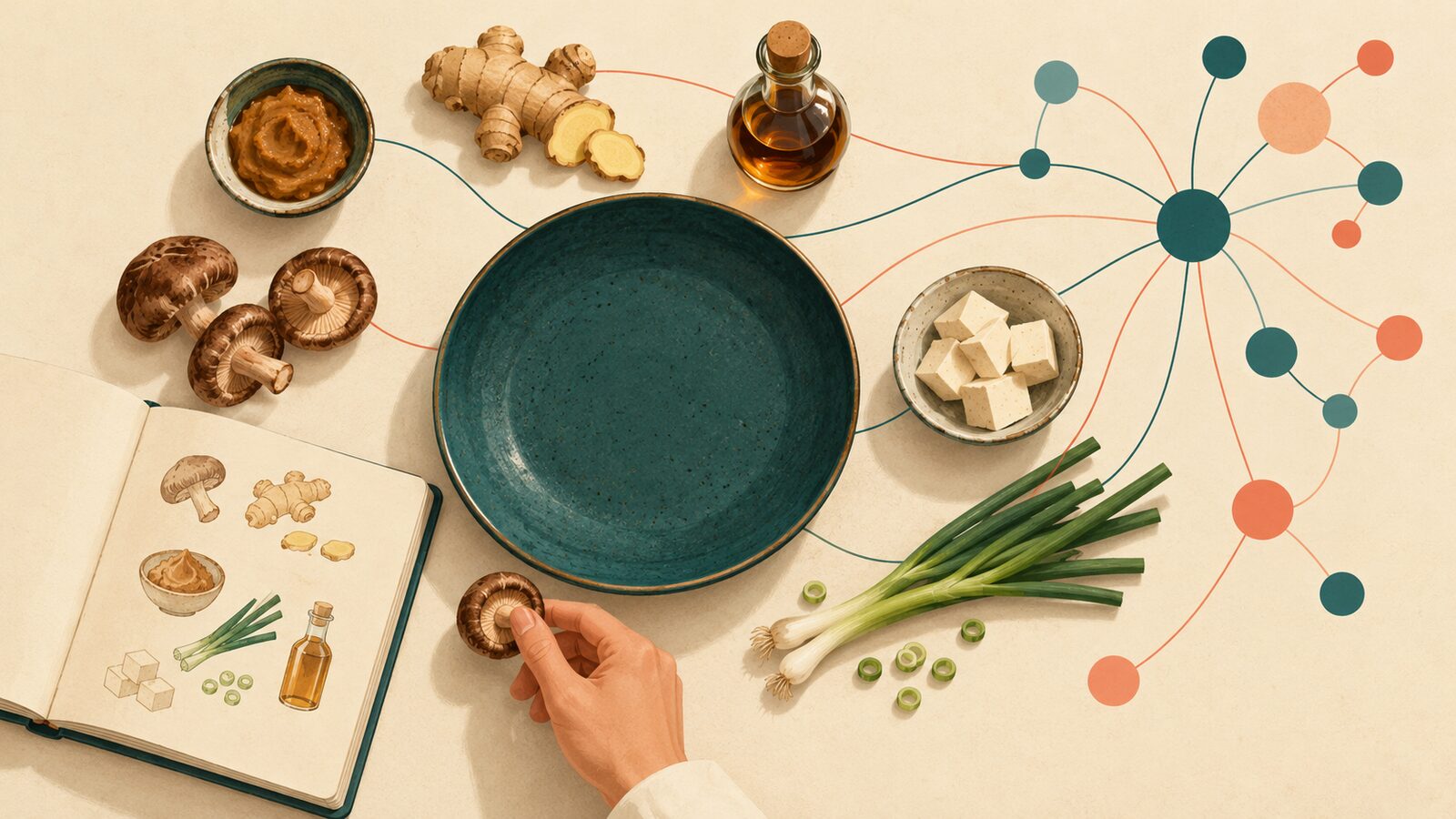
I used to be a chef. That probably explains why a video about ingredient embeddings managed to interrupt my scrolling so efficiently.
The paper was Epicure, and the question it brought back was older than the paper: how useful has AI actually become in a kitchen?
I had used IBM's Chef Watson around 2015, when AI was much less present in everyday life. My memory of it is positive. The suggestions did not leave me disappointed, and the service was useful for finding recipe inspiration. I wasn't waiting for a machine to take over dinner. Having something suggest a direction I might otherwise miss was already valuable.
So my starting point here is fairly generous: I already know that this kind of assistance can be useful to me. What I wanted to understand was how far the newer work takes it.
First, a correction to my cookbook memory
I remembered a Chef Watson cookbook, possibly involving the BBC. The book was real; my publisher lookup apparently needed a software update.
Cognitive Cooking with Chef Watson was a collaboration between IBM and the Institute of Culinary Education, published by Sourcebooks on April 14, 2015. It contained more than 65 recipes, developed and refined with human chefs. ICE's announcement
That human involvement matters to how I read the project. The cookbook is evidence of a workflow that produced recipes people could develop into a finished artifact. It doesn't establish that every raw machine suggestion was ready to serve.
IBM's technical account describes candidate generation and evaluation using ideas such as novelty, predicted pleasantness, and food pairing, alongside work on recipe quantities and procedures. It also reports a limited chef evaluation of a dessert whose proportions and steps involved human collaboration. IBM's Chef Watson research
That fits the value I remember: help at the point where I wanted another idea.
Epicure makes the meaning of “related” easier to inspect
Epicure builds ingredient embeddings from about 4.14 million recipes, using a vocabulary of 1,790 ingredients. An embedding gives each ingredient a numerical position, letting the system retrieve nearby ingredients.
The experiment compares three models with the same architecture and hyperparameters but different training walks: recipe co-occurrence in Cooc, compound-mediated connections in Chem, and a blend in Core. Epicure paper
The distinction becomes easier to understand with chicken. The Cooc model card lists garlic, onion, and black pepper among its nearest neighbours. The Chem card instead puts beef and pork near the top. Cooc examples, Chem examples
My cooking interpretation is that these lists suggest different questions. One is useful when thinking about companions for an ingredient. The other can suggest ingredients worth comparing for their profiles. Neither list, by itself, tells me how to substitute something in a particular dish.
If I ask what belongs alongside chicken and receive beef, the problem might be my choice of model rather than an absurd answer. “Similar” was doing quite a lot of unpaid work in that question.
There is a wrinkle: Chem is not a clean separation of chemistry from culinary culture. Its walks still use co-occurrence information to connect ingredients without direct compound coverage. Graph construction
I would therefore read this as a controlled comparison of graph constructions, with useful differences to inspect. I would be more careful about calling it chemistry stripped of human cooking habits.
What the public demo actually returned
A browser check for this article used the public Epicure Explorer on October 15, 2026. The basket was miso, ginger, and sesame oil, with eight results requested and the food-group filter set to All.
Cooc returned soy sauce and shiitake mushroom first. Core started with light soy sauce, oyster sauce, and scallion. Chem started with tofu and oyster sauce. Epicure Explorer
Those results give me something concrete to think about. I could explore mushrooms as the next ingredient, or build a tofu dish around the original basket. Those are possible next experiments, not dishes tested for this article.
The lists also overlap. The three models do not produce three entirely separate culinary worlds every time. For this basket, the interesting part was the change in emphasis.
The browser check establishes that a query ran and returned these candidates. It says nothing about whether a finished dish would taste better, how much of an ingredient to use, or which cooking method to choose. The cosine scores beside the results measure similarity within the models. I wouldn't read a higher number as a better dinner rating.
Where my confidence stops
The paper's taste-related evaluation includes LLM-assigned taste scores, rather than a human tasting panel. It also uses external nutrient data for evaluation. Supplement, section D.1
Those are useful checks on what the representation captures. They leave the question I care about as a former chef partly open: does following these suggestions improve the food?
There are reproducibility limits, too. The released corpus resources omit the raw recipes and ingredient-to-cuisine labels, and the Cooc model card says its public cuisine directions are reconstructed heuristically. Released resources, Model-card caveats
I would keep that qualification attached to any impressive example of moving an ingredient toward a different cuisine. Being able to download vectors and try a demo is useful access, but it doesn't reproduce every step of the research.
Would I use it?
For inspiration, yes. Chef Watson had already earned that answer from me years ago. Epicure gives me a more explicit way to explore why one candidate might appear: recipe context, compound-mediated relationships, or their combination.
For a kitchen trial, I would start small. Choose a dish I know, ask one specific question, and compare one suggested change against the original. Record the quantities and method, taste both, and decide whether the change deserves another attempt. That is the experiment I would want before calling a suggestion an improvement.
I don't see enough evidence here to say Epicure cooks better than Chef Watson did. The projects expose different kinds of output, and this reading provides no direct cooking comparison between them.
What does feel promising is the ability to ask a better question than “what goes with this?” Do I want a familiar companion, a surprising direction, or a candidate replacement that still needs testing?
My memory of Chef Watson is a reminder to set a useful bar. An idea generator can earn its place before it can write a complete, dependable recipe. Epicure gives me reasons to open the notebook again. The next useful result would come from cooking something.
Get the next post.
If you made it to the end, meet the next post in your inbox or RSS reader.